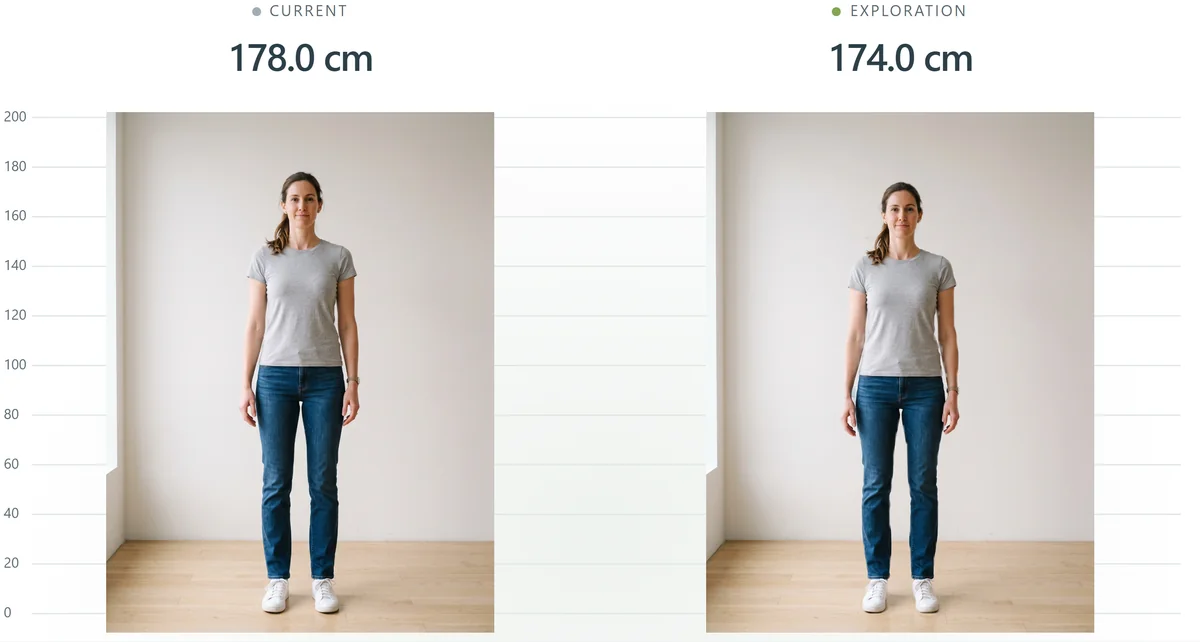
Leg shortening surgery at a glance
| Question | What the studies report |
|---|---|
| What is shortened | Usually the femur, the thigh bone. In people whose bones have finished growing, femoral shortening is considered safer than shortening the tibia, the shin bone (Coppola and Maffulli) |
| How | A section of bone is removed (osteotomy), the ends are brought together and held with a nail or plate. Closed techniques cut the bone from inside and fix it over a nail through a small incision (Blair 1989, Jahmani 2020) |
| How much at once | About 3–4 cm of length change at the operation (Vogt); an average of 4.2 cm in a six-patient series (Jahmani) |
| Effect on height | Any shortening procedure also lowers standing height (Vogt) |
| Main issues | Muscle weakness and limping while soft tissue adapts (Vogt); rotation and function problems with older closed techniques (Coppola and Maffulli) |
| In growing teenagers | Growth-plate surgery (epiphysiodesis) slows growth instead of cutting bone. It corrects differences of up to 5 cm (Willegger) and reduced the predicted final height of girls by 5.9 cm on average in one series (Laufer) |
This page summarises published research. It does not recommend surgery, and it is not medical advice.
Who has leg shortening surgery
- People with legs of different lengths. This is the main use. In a series of 20 young people whose bones had finished growing, the longer thigh bone was shortened until the pelvis was level, and the difference was 1 cm or less in all of them (Blair 1989). A review lists shortening osteotomy, growth-plate surgery and lengthening as options for differences of 2–4 cm (Vogt 2020).
- Teenagers predicted to be extremely tall. Surgeons block the growth plates around the knee to limit the remaining growth. One hospital did this in 34 patients, 16 of them girls. The girls were on average 175.2 cm tall at surgery and predicted to reach 191.4 cm. The operation reduced that prediction by 5.9 cm, which is 46% of their remaining growth (Laufer 2022). The review by Willegger and colleagues calls this the gold standard in the growing skeleton.
- Healthy adults who want to be shorter. We found no study. Growth-plate surgery is done in the growing skeleton, and cutting bone in a healthy leg is not what the papers above describe.
How leg shortening surgery works
- For a leg length difference, the surgeon works out from X-rays how much to shorten, for example by levelling the pelvis with lifts under the shorter leg (Blair).
- The femur is cut and a section is removed. The cut can be near the hip, near the knee, or in the middle of the shaft, fixed with a plate or a nail (Coppola and Maffulli).
- The bone ends are brought together and fixed so they can heal at the new length.
- Muscles and other soft tissue are now relatively too long for the shorter bone (Vogt).
Leg shortening surgery compared with lengthening
| Shortening | Lengthening | |
|---|---|---|
| The bone | A section is removed and the ends are fixed together at once | The bone is cut and then slowly pulled apart while new bone forms |
| Size of change | About 3–4 cm at the operation (Vogt) | Mean 6.9 cm (range 2–13) in 131 cosmetic patients, almost all with the tibia lengthened (Novikov 2014) |
| Soft tissue | Slack: temporary loss of muscle strength, even a limp (Vogt) | Stretch: 37% of those patients had complications, 37 of the 59 in soft tissue (Novikov) |
| Time | No standard timeline in the studies we read | 31 days in the frame per centimetre on average, so about seven months for 7 cm (Novikov) |
More about the lengthening side: shoe lifts vs limb lengthening and humerus lengthening.
Risks and recovery of leg shortening surgery
- Muscle weakness and limping. After a bone is shortened the muscles are relatively too long. The review describes passive muscle failure with loss of strength, even an observable limp, as a temporary consequence (Vogt).
- Rotation and function problems. Closed nailing was widely used, but frequent malrotation, loss of function and acute respiratory distress after reaming were reported. Nails locked at both ends and careful reaming are recommended (Coppola and Maffulli).
- Changed proportions. Shortening by more than 5 cm can noticeably change the proportion of legs to trunk (Vogt).
- Knee deformity after growth-plate surgery. In the girls-and-boys series, 5 of 11 patients with temporary implants developed angular knee deformity, against 1 of 23 with permanent ones. The team stopped using temporary implants for tall stature (Laufer).
- Planning error. Growth has to be predicted. The final size of a leg length difference in a growing child can be estimated to within about 2 cm (Vogt), so planning and timing decide the result (Willegger).
- General surgical risks. As with any major bone surgery, a surgeon also covers infection, blood clots and anaesthesia.
The studies we read give no common recovery timeline for shortening, because the patients, methods and fixation differ. Your surgeon sets how soon you can put weight on the leg, so ask for that before anything else.
Why some women look into changing their height
Height is a personal matter, and being tall or short is not a medical problem by itself. The research on why people want to change it is thin, and almost none of it follows women who had leg shortening surgery for height. This is what exists:
- Women do have cosmetic lengthening. 66 of 131 patients (50%) in a large Ilizarov series were women, who gained 6.5 cm on average against 7.3 cm for men (Novikov 2014). In a nail series only 8 of 32 were women (Kocaoglu 2017). The share depends on the centre.
- Fewer women than men say they would consider it. In a survey of 383 US adults, 27 (7%) would consider surgery to be taller: 7 of 187 women (3.7%) and 20 of 196 men (10.2%), calculated from the paper's counts. The items they endorsed most were a harmful effect of height on career prospects, then confidence and emotional distress (Lari and Alherz 2024).
- Media and social pressure play a part. Among 473 women and 231 men at a Chinese university, concern about stature was predicted by appearance pressure from the media and by monitoring one's own stature. Body surveillance predicted it for women but not for men (Sun 2017).
- Wanting to be shorter is barely studied. A 2025 review found height dissatisfaction in women underexplored and asked for measures that capture the wish to be shorter as well as taller (Schmidt and Talbot).
- Tall girls and the long view. Since the 1950s, tall girls have been given oestrogen to reduce their adult height. In an Australian follow-up, 99.1% of the 448 untreated women were glad they had not been treated, and 42.1% of the 396 treated women were dissatisfied with the decision. Dissatisfaction was linked to having little say in it, bad experiences of treatment and side effects, not to final height (Pyett 2005). This was hormone treatment, not surgery.
Reviewers of cosmetic lengthening recommend combining any surgical option with psychosocial support (Bulut 2025). If worries about your height weigh on you, a doctor or counsellor can help.
Lengthening and shortening at the same time
In the simulator, standing height changes with leg length only, because the torso does not change. So one segment can be shortened and another lengthened, leaving height the same while the knees move and the leg proportions shift. The figure shows thighs shortened by 3 cm and shins lengthened by 3 cm.
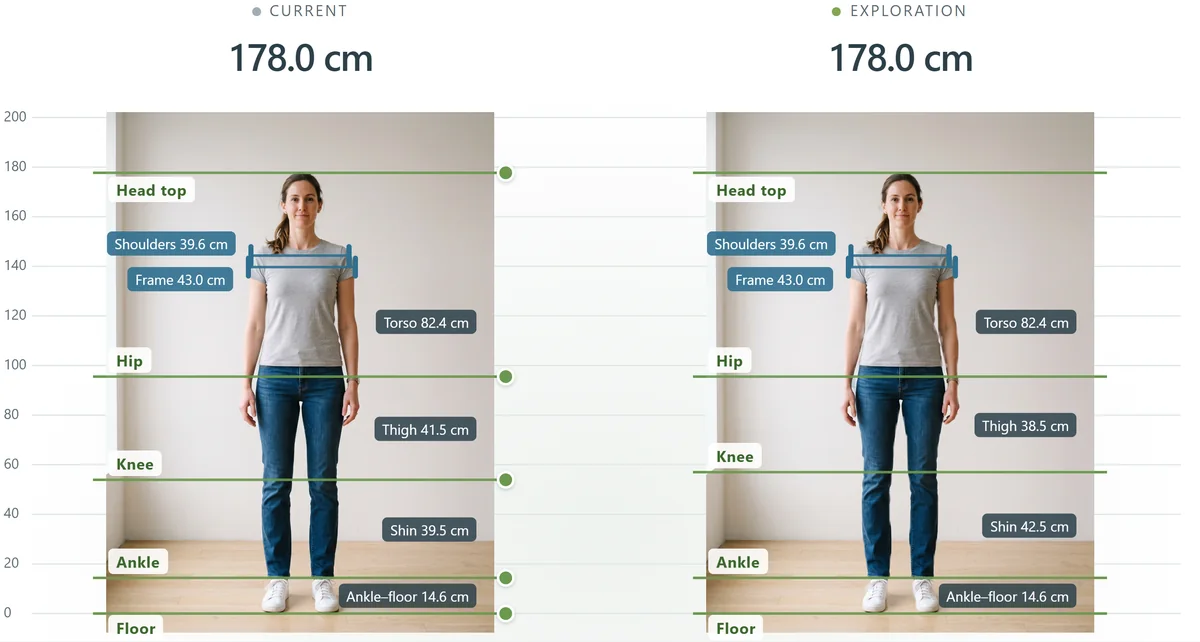
The arithmetic for that photo, where the simulator estimated a 41.5 cm thigh and a 39.5 cm shin:
| Change to both legs | Height | Thigh | Shin | Shin ÷ thigh |
|---|---|---|---|---|
| None | 178 cm | 41.5 cm | 39.5 cm | 0.95 |
| Thighs −4 cm | 174 cm | 37.5 cm | 39.5 cm | 1.05 |
| Shins −4 cm | 174 cm | 41.5 cm | 35.5 cm | 0.86 |
| Thighs −3 cm, shins +3 cm | 178 cm | 38.5 cm | 42.5 cm | 1.10 |
Shortening a thigh keeps the knees where they were and lowers the hips and everything above. Shortening a shin lowers the knees. Doctors do combine both directions for leg length differences, by shortening one leg and lengthening the other in one operation when the difference is large (Coppola and Maffulli). We found no study that does it for looks. See also the femur to tibia ratio page, and how the ape index changes when legs get shorter.
Preview it on your own photo
Try the Thigh · femur and Shin · tibia sliders. Upload a full-body photo and your height, then drag either slider left to shorten or right to lengthen, and watch your height and leg proportions change at the same scale.
Open the simulator with the thigh and shin sliders highlighted
The shortening range of the sliders goes further than real leg shortening surgery does, because about 3–4 cm is what the operation itself achieves (Vogt). Your photo is processed on your device and never uploaded. The same limb lengthening simulator previews upper-arm changes too. To line yourself up with someone else afterwards, use the height comparison tool.
Sources
- Vogt B et al. Leg length discrepancy: treatment indications and strategies. Deutsches Ärzteblatt International, 2020.
- Coppola C, Maffulli N. Limb shortening for the management of leg length discrepancy. Journal of the Royal College of Surgeons of Edinburgh, 1999.
- Blair VP et al. Closed shortening of the femur. Journal of Bone and Joint Surgery (American), 1989.
- Jahmani R et al. Percutaneous femoral shortening over a nail using on-site smashing osteotomy technique. European Journal of Orthopaedic Surgery and Traumatology, 2020.
- Laufer A et al. Preliminary results of two novel devices for epiphysiodesis in the reduction of excessive predicted final height in tall stature. Journal of Orthopaedics and Traumatology, 2022.
- Willegger M et al. Epiphysiodesis for the treatment of tall stature and leg length discrepancy. Wiener Medizinische Wochenschrift, 2021.
- Novikov KI et al. Cosmetic lower limb lengthening by Ilizarov apparatus: what are the risks? Clinical Orthopaedics and Related Research, 2014.
- Kocaoglu M et al. Results of cosmetic lower limb lengthening by the lengthening over nail technique. Acta Orthopaedica Belgica, 2017.
- Lari A, Alherz M. Cosmetic stature lengthening: an investigation into sociodemographic determinants and public perceptions. JAAOS Global Research and Reviews, 2024.
- Sun Q. Predictors of stature concerns among young Chinese women and men. Frontiers in Psychology, 2017.
- Schmidt NP, Talbot D. Standing tall or falling short: a narrative review of height dissatisfaction and psychological outcomes. PLOS Mental Health, 2025.
- Pyett P et al. Using hormone treatment to reduce the adult height of tall girls: are women satisfied with the decision in later years? Social Science and Medicine, 2005.
- Bulut H et al. Meta-analysis of complications and functional outcomes in cosmetic limb lengthening. Journal of Orthopaedics, 2025.
Compiled from the papers above and last checked on 30 September 2026; figures are as those papers report them. The AI-generated photo shows a fictional person. Talk to a qualified orthopaedic surgeon before deciding anything.